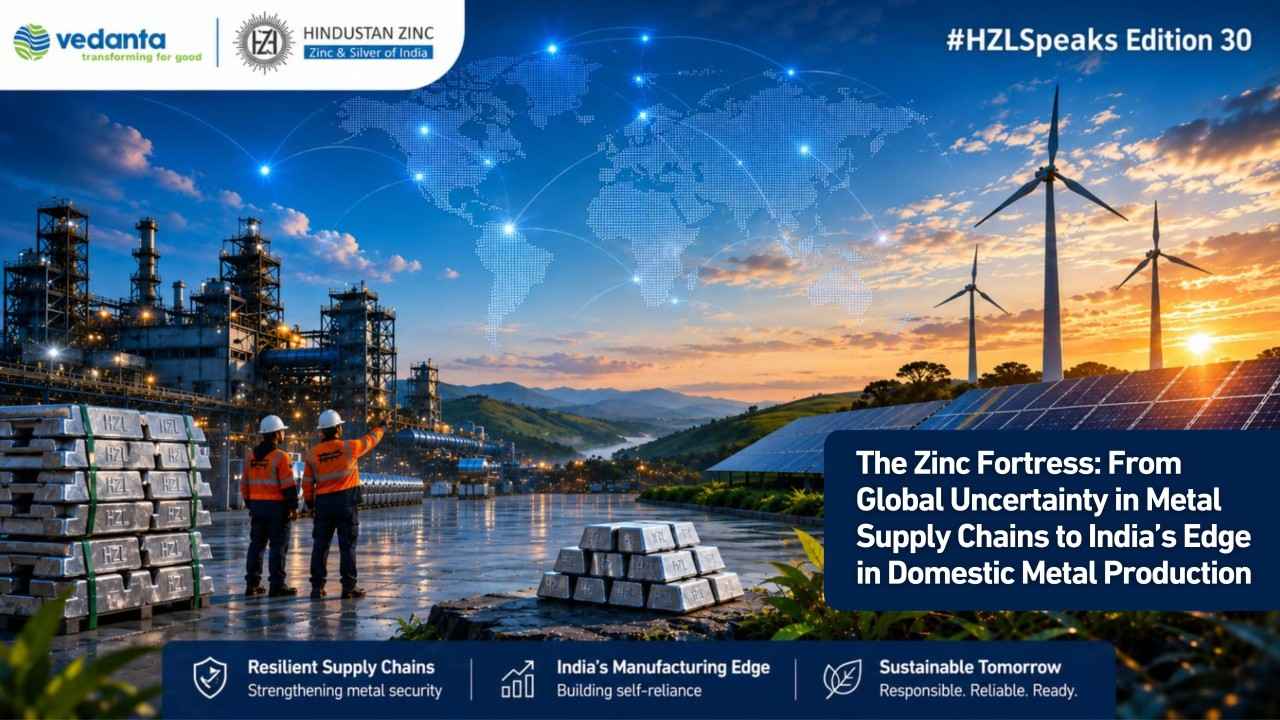
Metal’s mood swings are here igniting one important question – how volatile global supply chains are shaking things up, and why India’s strong domestic production has us cutting through the chaos!
When global supply chains fracture, the nations that survive are those that mine their own futures. Over the last three months, renewed conflicts in West Asia and volatile energy costs have pushed the global metals market into deep uncertainty. While overseas smelters are losing money due to high energy costs and a global shortage of raw mining ore, India’s factories remain insulated on account of long-term supply contracts and reliable local power.
The reason is an asymmetry in the critical minerals race: India has built complete domestic sovereignty over zinc.
Zinc is no longer just a legacy industrial metal used to galvanize steel; it is a foundational component of the green energy transition, vital for solar trackers and next-generation grid storage. Most industrial nations rely on a hyper-fragmented supply chain, buying raw ore from one continent and shipping it to another for high-emissions smelting. This model fails during geopolitical friction.
India’s comparative advantage lies in structural integration. By anchoring its supply chain within its own borders, primarily via Rajasthan’s rich deposits, India bypasses the cross-border vulnerabilities that cripple foreign competitors. Controlling three-quarters of the domestic market, Hindustan Zinc Limited (HZL) functions as a strategic economic moat. HZL retains its competitive advantage because its operations are fully integrated from exploration to smelting. Additionally, the domestic infrastructure boom remains completely unaffected by global shipping price spikes and fuel bottlenecks.
As European and Asian smelters grapple with carbon taxes and erratic fuel supplies, India’s model demonstrates that sustainability and self-reliance are financially defensive. HZL’s structural cost protections and scaling green energy power contracts allow it to produce high-grade zinc that easily clears strict international ESG import regulations.
The disruptions of the last quarter show that mineral security cannot be outsourced. In a fragmented world, the true winners are not just those with resources in the ground, but those who control the entire value chain from pit to port. India has built a fortress around its zinc supply, and the rest of the world is now forced to take notice.